
Give AI agents spending power. Keep control.
An open-source payment policy gateway for AI agents. Set spending limits, require human approval, control session budgets, and audit every payment decision.
Public playground is a mock sandbox - no real money ever moves.
$ pip install sanestlypay
$ sanestlypay-gateway

POST /v1/request-payment
{"amount_usd": "150", "category": "hosting"}

<- {"decision": "REQUIRES_APPROVAL",
    "approval_id": "apv_9f2..."}
How the gateway works
Every payment request is evaluated against policy before a provider is ever called. The agent gets a decision, not a credit card.
- Your agent asks. A signed request describes amount, category, merchant, and justification. It never holds card secrets.
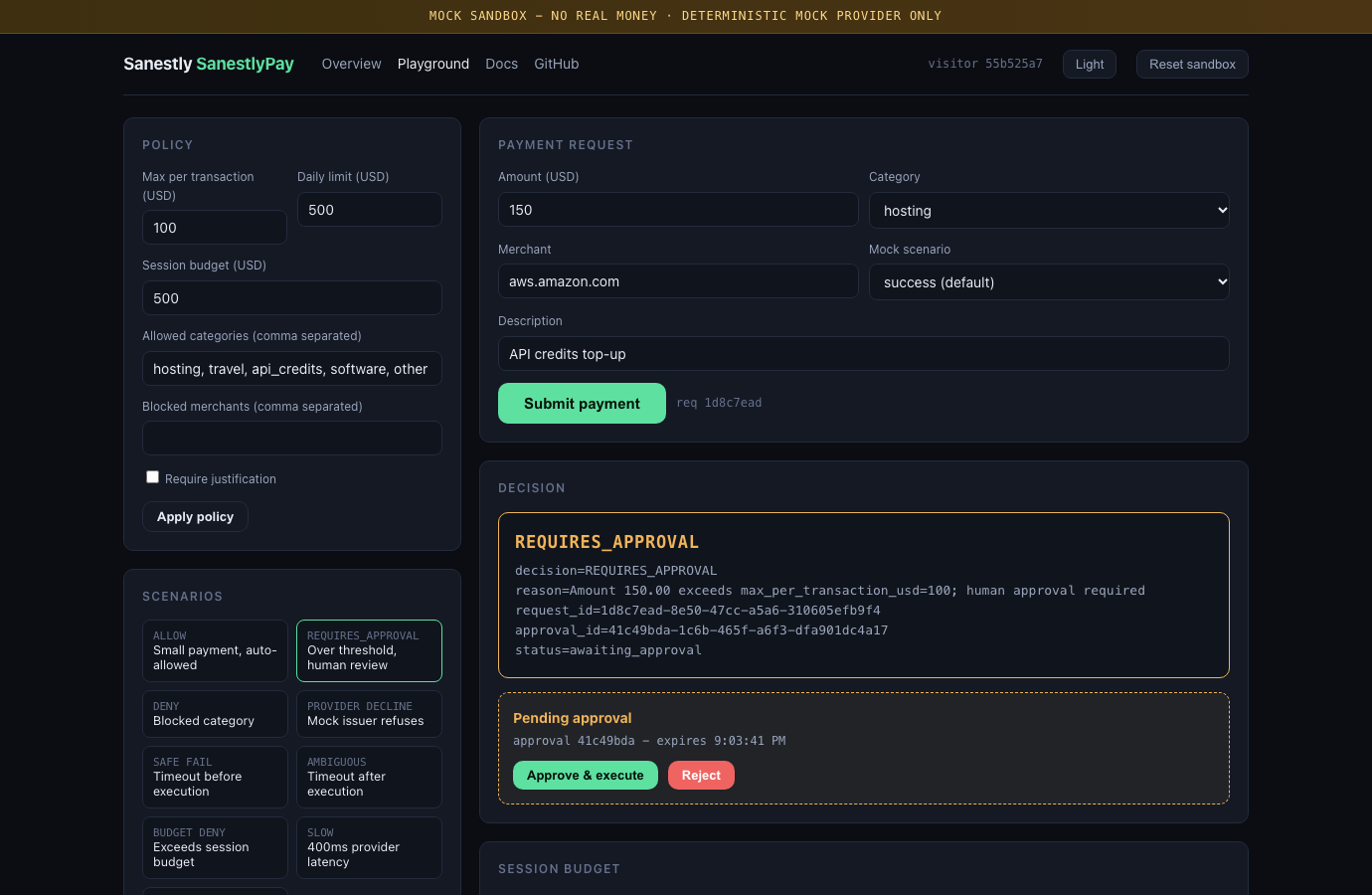
- Policy decides. The gateway answers ALLOW, DENY, or REQUIRES_APPROVAL. Approval amounts reserve session budget atomically - concurrent requests cannot overspend.
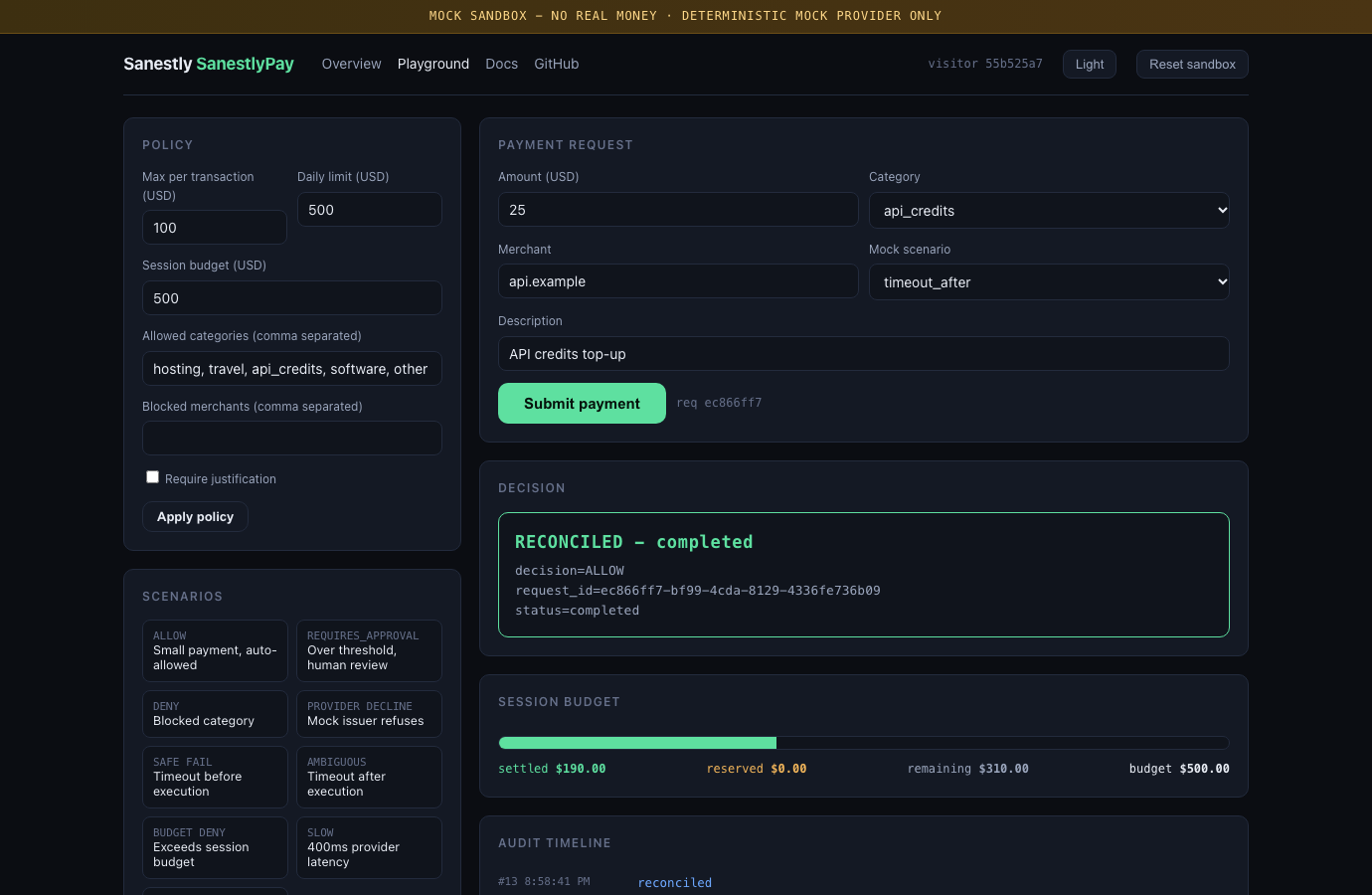
- A human resolves or the provider settles. Approvals are single-use; ambiguous provider outcomes are reconciled, never guessed. Every step lands in the audit trail.
Try a real decision
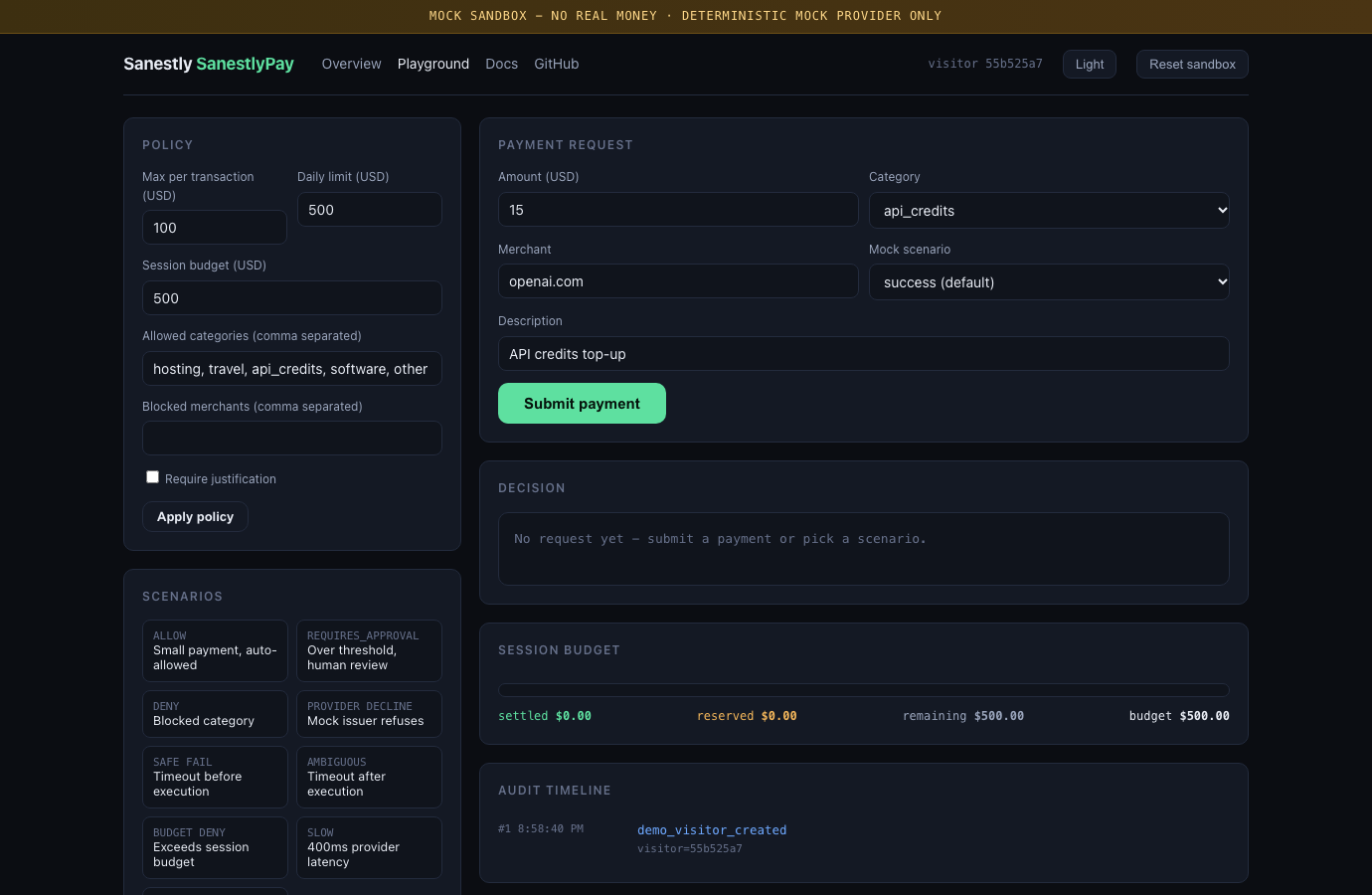
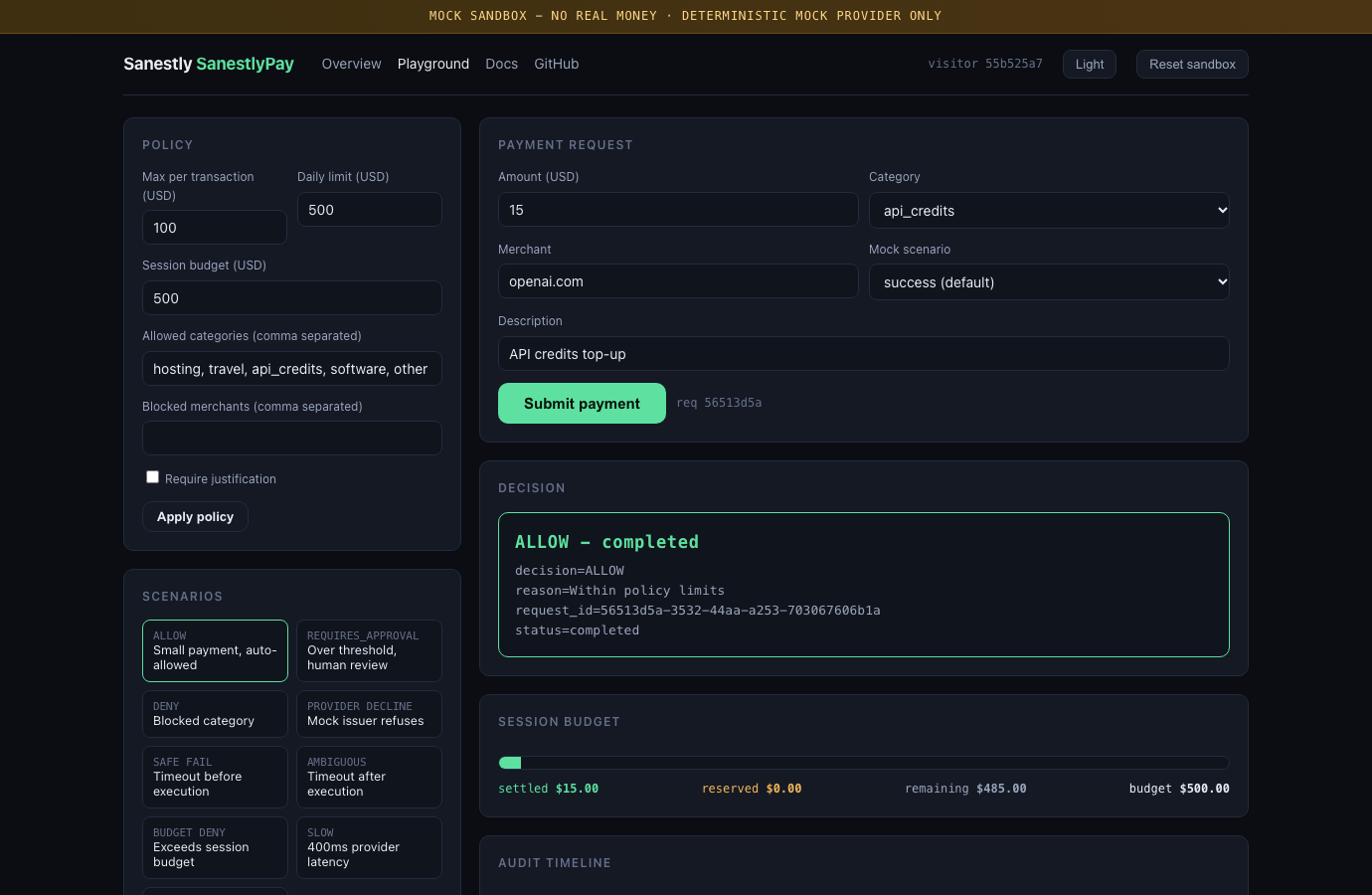
This widget talks to the live SanestlyPay gateway in mock mode. Same code path as the full Playground, no registration.
The interactive Playground
Nine scenarios in a credential-free visitor sandbox: allow, approval, rejection, denied category, budget limits, idempotent replay, provider timeout with reconciliation, session abort, and webhook inspection. Edit the policy, watch the budget bar, read the audit timeline.
Mock sandbox - no real money. Visitor sandboxes are isolated and reset automatically.
Spend controls that hold up under concurrency
Built for agents that run fast and in parallel - the rules are enforced in the database transaction, not in hopeful client code.
Spending policies
- Per-payment, per-session, and daily limits
- Allow and deny lists for categories and merchants
- Approval thresholds above amounts you choose
- Policy is evaluated before any provider call
Human approvals
- Scoped API keys - an agent cannot approve itself
- Single-use approvals via compare-and-set
- Approver dashboard with CSRF-protected sessions
- Rejections release the reserved budget immediately
Session budgets
- Atomic reservations hold funds while approval is pending
- Kill-switch aborts a session and releases holds
- Reserved, settled, and remaining amounts stay consistent
Audit and recovery
- Durable audit trail for every decision
- Provider timeouts reconcile instead of guessing
- Recovery sweep after restarts; webhook outbox retries
Providers - honest status
SanestlyPay is mock-first. Real money only moves through providers you configure with your own credentials.
| Provider | Status |
|---|---|
| Mock provider | Verified end-to-end in CI and on the public demo |
| Stripe Issuing | Integration implemented; needs your Stripe credentials |
| x402 | Payer flow implemented with wallet signing; testnet verification pending |
SDKs, MCP, and framework integrations
One OpenAPI contract, HMAC-signed clients, and typed errors across ecosystems. MCP tools are read-only for approvals - an agent can ask, never self-approve.
| Language | Package | Distribution |
|---|---|---|
| Python | sanestlypay | PyPI |
| TypeScript / Node | sanestlypay | npm |
| PHP | sanestly/sanestlypay | Packagist |
| Ruby | sanestlypay | RubyGems |
| Rust | sanestlypay | crates.io |
| Java | com.sanestly.sanestlypay | source (Maven Central pending) |
| Swift | SanestlyPay (SwiftPM) | git tag |
Plus an MCP server (uvx sanestlypay) and examples for LangChain, OpenAI tools, CrewAI, AutoGen, and LlamaIndex.
Quick start
Credential-free local run - the demo uses the same gateway code with a mock provider and a throwaway SQLite database.
git clone https://github.com/dedalik/agentpaysdk.git
cd agentpaysdk
make demo

# open http://127.0.0.1:8080/sanestlypay/demo
{
  "mcpServers": {
    "sanestlypay": {
      "command": "uvx",
      "args": ["sanestlypay"]
    }
  }
}
Security, said plainly
SanestlyPay reduces the blast radius of a misbehaving agent. It is not a payment processor and not a custody product.
- Scoped keys: agent, approver, operator - separation of duties by design
- HMAC-signed requests, idempotency keys, request-size limits, webhook SSRF guards
- No raw card numbers in agent-facing responses, ever
- Fail-closed startup: production refuses to boot on default secrets
- Live-provider settlement still requires your own verification and credentials
- Independent audit report and threat model ship in the repository
Open source, MIT licensed
Self-hosted, local-first, no Sanestly account required. Issues, ideas, and pull requests welcome on GitHub.